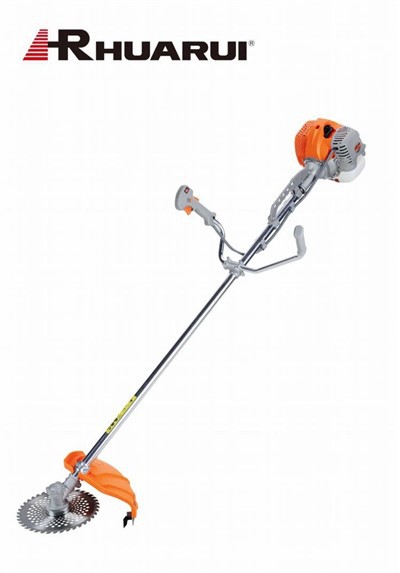
Q: What is a gasoline brush cutter and uses?
A: A gasoline brush cutter, also known as a string trimmer or weed whacker, is a handheld power tool designed for cutting grass, weeds, and small branches. It is commonly used in landscaping, gardening, and agricultural settings where maintaining vegetation is necessary.
Q: How does the power and efficiency of a gasoline brush cutter compare to electric models?
A: Gasoline brush cutters typically offer more power and greater runtime compared to electric models, which makes them suitable for heavy-duty tasks and areas without access to electrical outlets. However, they are heavier and louder than electric trimmers and require regular maintenance of the engine.
Q: What safety features should I consider when choosing a gasoline brush cutter?
A: Safety features to look for include a trigger lock to prevent accidental starts, an inertia-activated stop switch for quick shutdown, a protective shield to deflect debris, and an adjustable handle for comfort and control. Additionally, always use appropriate personal protective equipment (PPE), such as goggles, ear protection, gloves, long pants, and closed-toe shoes.
Q: What maintenance tasks are required for a gasoline brush cutter?
A: Regular maintenance includes checking and changing the spark plug, cleaning or replacing the air filter, draining old fuel and mixing fresh fuel, and keeping the cutting line at the proper length. The cutting head should also be inspected for damage and wear.
Q: Can a gasoline brush cutter be used for heavy-duty clearing or felling tasks?
A: While gasoline brush cutters are versatile and powerful, they are not designed for heavy-duty tasks such as felling large trees. They excel in clearing underbrush, trimming around obstacles, and maintaining lawn edges but may struggle with thick woody stems or trunks.
Q: What type of fuel does a gasoline brush cutter use, and how should it be stored?
A: Most gasoline brush cutters use a mixture of unleaded gasoline and two-cycle engine oil. This mixture should be prepared according to the manufacturer's specifications. Fuel should be stored in a clean, sealed container in a cool, dry place away from direct sunlight and heat sources.
Q: How often should the cutting line on a gasoline brush cutter be replaced?
A: The cutting line will wear down over time and should be replaced when it becomes too short or shows signs of significant damage. The frequency of replacement depends on usage but can range from several uses to once a season, depending on the toughness of the vegetation being cut.
Q: How do I start a gasoline brush cutter?
A: To start a gasoline brush cutter, follow these general steps: Mix fuel, prime the engine, set the choke (if applicable), open the fuel valve, and pull the starter cord until the engine fires up. Once the engine is running smoothly, release the choke and let it warm up before use. Always refer to the owner's manual for specific instructions.
Q: How do I dispose of a gasoline brush cutter responsibly when it's no longer functional?
A: Dispose of a gasoline brush cutter responsibly by taking it to a local recycling center or hazardous waste facility that handles electronic waste. Check with your local waste management authority for proper disposal options and guidelines, as some areas may offer collection events for power tools. Never dispose of a brush cutter in regular trash or by burning it.
Q: What are the different types of brush cutters?
A: They are great for cutting saplings and weeds that have grown too tall. Walk-behind brushes are ideal for large areas and for overgrown brushes. Tow-Behind They're ideal for work in extensive landscapes and thick brush areas such as abandoned fields, and similar.
Q: What is the difference between a brush cutter and Weedeater?
A: To keep things in simple terms, a grass trimmer is suited to trimming edges, hard to reach lawn areas, and providing finishing touches to lawns. On the other hand, brushcutters are designed to take on dense weeds, fibrous grass and areas of thick vegetation that a grass trimmer would struggle to cut.
Q: What is the difference between a bush hog and a brush cutter?
A: One of the most useful tools is what is known as a “brush hog” or “rotary cutter.” Brush hogs are commonly called “bush hogs” but that is a brand name. “Rotary cutter” is another commonly used term to describe the same implement.
Q: Can I use a brush cutter as a trimmer?
A: Brush cutters can clear grasses and weeds or edge a walkway in the same manner as a string trimmer, but they are primarily designed to handle much more dense types of brush and undergrowth— powerful enough to cut down thick saplings and even small trees.
Q: What is the difference between a lawn mower and a brush cutter?
A: The differences lie in the power of the engine, the heft of the blade, the ruggedness of the frame, and the available controls. While traditional lawn mowers generally have engines with 2 to 6 HP, brush mowers will have between 10 and 20 HP.
Q: What is the difference between a 2 stroke and 4 stroke brush cutter?
A: If represented by numbers, the fuel consumption of a 4-stroke brush cutter is about half that of a 2-stroke brush cutter, that means if the same amount of gasoline, a 4-stroke brush cutter can run for 2 hours, while a 2-stroke brush cutter can only run for 1 hour.
Q: How thick a branch can a brush cutter cut?
A: Walk-behind brush cutters: Also known as brush mowers or weed mowers, these excel at clearing thick vegetation over larger areas. They are capable of tackling saplings up to 2 inches in diameter, thick brush up to 6 feet tall and grasses and weeds over 8 feet tall.
Q: What type of engine is commonly used for brush cutters?
A: Typically speaking, brush cutters run on either a two-stroke or a four-stroke engine. Two-stroke engines tend to be lighter than four-stroke engines, but they are also more difficult to start and less efficient. While being more powerful, four-stroke engines are more expensive and less common.