


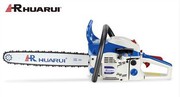
62cc Gasoline Chain Saw
MODEL: HR6528E
DISPLACEMENT: 62cc
BORE&STROKE: 47.5*34 mm
What is Gasoline Chain Saw
A gasoline chainsaw is a machine that cuts with a set of teeth attached to a rotating chain driven along a guide bar. It is used in activities such as tree felling, limbing, bucking, pruning, cutting firebreaks in wildland fire suppression, and harvesting of firewood. Chainsaws with specially designed bar-and-chain combinations have been developed as tools for use in chainsaw art and chainsaw mills.
Types of 62cc Gasoline Chainsaws
There are two types of gasoline chainsaws, two strokes and four strokes. The 2-stroke version mixes the oil and gasoline and pour it into the engine's oil tank. The 4-stroke cycle does not require oil or gas mixing. It has two different tanks for gasoline and oil.
Parameters
|
MODEL |
HR6528E |
|
DISPLACEMENT |
62cc |
|
BORE&STROKE |
47.5*34 mm |
|
RATED POWER OUTPUT |
2.6kw/3.5Hp |
|
IDLING SPEED |
3000rpm |
|
OIL/FUEL RATIO |
1:30 |
|
FUEL TANK CAPACITY |
680ml |
|
OIL TANK CAPACITY |
360 |
|
WEIGHT(W/O BAR&CHAIN) |
5.3kg |
|
CHAIN&BAR SIZE |
22" .3/8-76LPX |
How Does a Gasoline Chain Saw Work?
Unlike electric chainsaws, which run on battery power, gas chainsaws run on gasoline. The fuel is poured into the chainsaw's engine, which is then turned by the clutch. Standard unleaded gasoline is recommended for chainsaws. It is more powerful and doesn't require carburetor maintenance. The octane number should be around 89.
The chain is driven by an engine and the chain has links that feature a metal finger called a "drive link." The drive link locates the chain on the bar, carries the lubricating oil around the bar, and engages with the engine's drive sprocket. The engine pulls the chain along a track using a centrifugal clutch. The clutch engages the chain as the engine speed rises and disengages it when the engine is idle.
Features of 62cc Gasoline Chain Saw
- Large engine
- Longer rod and chain
- Tool-free locking nut
- GS CE standard safety front shock absorber
- Optional starter ball, easier to start the engine at low temperature
- Double-layer nylon mesh air filter with high density and better dustproof performance
- Quick brake structure ensures the machine brakes within 0.12S
- Gear tension screw system ensures easier adjustment of the saw chain
- Classic and popular appearance design
- Aluminum durable crankcase
- Huarui self-produced powerful cylinder
4 Top Benefits of Using a Petrol Chainsaw
1. Ability
Equipped with a two-stroke motor, a petrol chainsaw is much faster and more powerful compared to other types of chainsaws. The bigger power output allows the device to attack the hardiest cutting jobs with relative simplicity. The larger power also allows petrol chainsaws to be fitted with bars which are longer than their counterparts are capable of supporting. Some versions are capable of supporting blades up to 90cm and more. Longer blades mean no tree, no matter how difficult or thick, is uncuttable. Do more work in less time.
2. Mobile
Since the chainsaw is powered by petrol, you do not have to fret about the lack of a source of electricity. Cut everything you desire without worrying about electrical generators or sockets. This sort of chainsaw is easier to maneuver because there are no bulky and thick cables attached to it. Last, you don't need to take into account the battery's life; only refuel the saw once the petrol runs out.
3. Versatile
You can depend on a petrol chainsaw to tackle any job. Its rugged design allows you to fit it with a massive choice of bar spans from the normal 12-inch blade right to a huge 60-inch blade. 12-inch bars can perform several smaller jobs like trimming, splitting, and firewood cutting edge. Substantial jobs like felling midsized to large lumber and softwood trees, limbing and bucking require longer bar spans.
4. Durable
Petrol chainsaws are created with durability in mind. They are designed to cut through the toughest wood, and you are set to work long hours under harsh weather. With routine maintenance, your chainsaw may persist for quite a while.
How to Get Your Chainsaw Started
There are two correct ways to start your chainsaw: on the ground or with the saw between your legs. No matter which starting method you choose, remember that the chain brake should always be activated. Many chainsaw models can be started in what is known as half-throttle position. If the brake is not activated when starting one of these models, the chain may rotate.
Starting a Cold Engine
- Activate the chain brake.
- If the model is equipped with a decompression control – press this.
- Activate the choke. If the saw is equipped with Air Purge/fuel pump, press the bulb a few times until the fuel is visible inside it and thereby enters the carburettor.
- Starting on the ground: Put your right foot in the rear handle and keep a firm grip on the front handle with your left hand. Starting with the saw between your legs: Place the rear handle between your thighs and behind your right knee. Hold the front handle firmly with your left hand.
- Pull the starter handle with your right hand. Repeat until the engine fires.
- Push the choke (half-throttle) and pull until the saw starts.
- Accelerate so that the engine idles and then release the chain brake.
Starting a Hot Engine
When the engine is hot, it'll start without the choke. Follow the instructions above, but disregard the points relating to the choke. If the engine is difficult to start, apply half-throttle. You access the half-throttle function by first fully activating the choke, then moving the control back.
Buying Guide: Choosing The Best Gasoline-Powered Chainsaw
Understanding Bars and Chain Types
A good rule to keep in mind is that the chainsaw bar should be 2 inches longer than the wood you're cutting. When purchasing a saw, it will come with a guide bar that's a specific length. Be sure to also check if the saw can use other guide bar lengths. There are three main types of chainsaw chains.
- Low-profile chains are designed to reduce kickback for less experienced chainsaw users. The cutting corners are rounded.
- Semi-chisel chains are good for all-purpose cutting. They work well for both hardwoods and softwoods. The cutting corners are rounded, but not as much as low-profile chains and there's a greater risk of kickback. The slightly rounded cutting corners mean the chains don't go dull as quickly as full-chisel chains.
- Full-chisel chains cut more quickly through hardwoods. However, they also go dull more quickly and the increased risk of kickback makes them less safe to use, especially if you're not very experienced with chainsaws. Typically, only professionals will use full-chisel chains.
Chain Saw Power
In addition to bar length, you can also measure chainsaws based on engine displacement. This has to do with how powerful the saw will be. You'll see engine power listed in cc (cubic centimeters). The higher the number, the more powerful the saw and the longer the guide bars it can handle.
- A 30-cc to 40-cc engine will be good for light cleanup and cutting small tree limbs (comparable power level to most battery-powered saws).
- A 40-cc to 60-cc engine will be a good choice for cutting firewood or felling small trees, (comparable to 60 V or 80 V battery saws).
- A 60-cc to 120-cc engine can handle more demanding professional use (no comparable battery-powered saws in this power range).
How You'll Use the Saw
What you want to do with the chainsaw determines what type of saw you'll need. If you just want to trim some limbs around the house, you won't need a very powerful saw. If you're a professional logger, though, you'll want a heavy-duty chainsaw that can work with you all day.
- Light trimming is easy to do with a lightweight homeowner saw with a cutting bar length of around 6 to 12 inches and a 25-cc to 45-cc engine.
- Firewood cutting and storm cleanup depend on how large the trees you're cutting are, but a mid-range homeowner saw or a farm and ranch saw with a 14- to 18-inch bar and 40-cc to 60-cc should do the trick.
- Heavy-duty cutting requires powerful, professional saws, often with cutting bars over 20 inches in length and 50-cc to 120+-cc engines.
Features to Look For
As you narrow down your chainsaw selections based on how you'll use the saw, keep an eye out for other useful features as well.
- Chain brake - a safety feature that stops the chain if the saw moves abruptly, as in the case of kickback.
- Anti-vibration - a comfort feature that makes it easier to use the chainsaw and reduces operator fatigue.
- Easy start - this feature can go by different names (e.g. spring-assisted start), and it's designed to make gasoline-powered saws easier to start.
- Toolless chain adjust - a feature that lets you adjust the tension on the chain without needing an extra tool.
Gasoline Chainsaw Safety Tips: Avoiding Accidents and Injuries
Gasoline chainsaws make cutting and trimming jobs easier, but safety is paramount. To avoid accidents, you'd better follow these tips:
Wear protective gear: Use eye and ear protection, gloves, steel-toed boots, and a hard hat or helmet.
Choose a chainsaw with a chain brake: This safety feature stops the chain in case of kickback.
Operate with both hands: Grip the handlebars firmly to maintain control.
Maintain a safe distance: Stay away from people, objects, and animals to prevent injury from kickbacks or debris.
Check the chainsaw: Inspect for damage, ensure proper chain tension and sharpening, and confirm all safety features are functional.
Use the right size chainsaw: Select a chainsaw appropriate for the task.
Follow manufacturer's instructions: Adhere to maintenance, operation, and safety guidelines.
Electric vs. Gasoline Chainsaw: A Side-by-side Comparison
Price Comparison
When choosing between an electric or a gasoline chainsaw, the price can be essential in determining which model is best for you. Generally speaking, electric chainsaws are less expensive than gasoline chainsaws because they are more straightforward in construction and do not have engine parts that require regular maintenance and repairs. Generally speaking, you can pay around $50 to $100 for a reliable electric chainsaw and a good quality gasoline chainsaw for about $80 to $150, depending on the size and power output you need.
Performance Comparison
Get your adrenaline pumping with the sheer power of a gasoline chainsaw cut! Gasoline chainsaws provide greater power output than electric chainsaws.
Durability Comparison
Although electric and gasoline chainsaws offer durable designs, it is essential to consider how each type of chainsaw will withstand various environmental conditions, such as extreme temperatures or humidity levels, before purchasing. Gasoline chainsaws are more durable than electric chainsaws due to the internal combustion engine, which provides additional protection from damage caused by extreme temperatures or humidity levels compared to electric chainsaws.
Maintenance Comparison
Finally, the maintenance required for electric and gasoline chainsaws must be considered before purchasing. Electric chainsaws require very little maintenance -- other than regular lubrication and sharpening of the saw chain -- while gasoline saws require frequent oil changes and spark plug adjustments to keep them running at peak performance levels over time.
Chainsaw Maintenance Tips
Check the Chain, Chain Brake and Tension
Before each use, perform a quick maintenance check on your chainsaw before revving the engine to check the chain safety and tension. Wearing work gloves, clean the chainsaw by scraping out any debris inside the track. Inspect the air intake vent for debris in the slots. Finish the exterior inspection by checking all nuts, bolts and screws are tightly secured. Sharpen your chain using the file size recommended by the manufacturer, inspect its condition and replace it if damaged. Check the chain tension to ensure it's not too loose, and tighten it if necessary.
Inspect the Lubrication System
While the chainsaw is running, check the lubrication system is working and that oil is being fed to the chain. Place a sheet of white paper down and rev the chainsaw engine. You should see oil spray marks on the paper. If not, clean the oil reservoir and replace the filter. Lubricate the clutch drum bearing between every few uses. This prolongs the life and performance of your clutch. Keep lubricant on hand to make maintenance efficient and hassle-free.
Clean the Air, Fuel and Oil Filters
Clogged air filters lead to restricted airflow, causing the engine to overheat. Remove the cylinder cover to access the air filter. Remove the filter. Use a can of compressed air and spray from the inside out to remove light dust and debris. If a good cleaning doesn't remove everything, replace the air filter.
For gas-powered chainsaws, the fuel filter is located under the fuel cap. Look for a small cylinder attached to the end of a tube. Remove the filter from the tube, and insert a new filter every few months. All chainsaws also have an oil filter located under the cap of the bar lubricating tank. Fish the filter out and inspect it for dust. Clean with gasoline or replace if too much debris and dirt are present.
Rotate the Bar and Tighten Loose Parts
The narrow groove on the edge of the chainsaw bar holds the chain as it rotates during use. The friction and pressure cause the bar to wear down on one side over time. Before use, inspect your bar. Using cloth wipes, clean out the bar groove to prevent excessive wear. Inspect the lubrication hole and remove any clogs. With the vibration created by the engine, some screws, nuts, bolts or parts may shake loose during use. Inspect your saw before and after use for loose parts and secure them as needed.
Clean Your Carburetor, Fins and Tanks
Your chainsaw's cooling finds are located on the cylinder. They ensure proper heat distribution and cooling for safe use. Once every few uses, wipe the cooling fins down and remove dust, dirt and debris buildup. Clean the carburetor and your air box. Check the screen in your chainsaw's muffler. Clean it off, removing as much dust as possible. If the screen is damaged or very dirty, replace it. Once every month or two, clean your tanks. Old gasoline can leave a gunky residue. This residue build-up is bad for your engine and fuel consumption.
Hot Tags: 62cc gasoline chain saw, China 62cc gasoline chain saw manufacturers, suppliers, factory, Wood Cutting Machine Petrol, Gasoline Chain Saw 58cc, , ,


Send Inquiry
